

Voyage Overview
Explore the legendary Northwest Passage on this cruise, while watching for arctic wildlife.
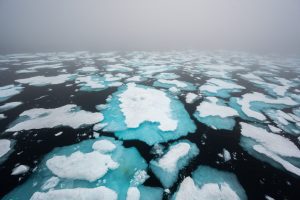
The labyrinthine channels of the legendary Northwest Passage have enchanted explorers and adventurers for centuries. Get a glimpse into the world that captivated early explorers such as Franklin, Amundsen and Larsen, by exploring a portion of the fabled Northwest Passage. Visit the final resting places of some of the legendary explorers to have ventured here and experience the archipelago of islands and channels that make up Canada’s High Arctic region. Learn about the region’s ancient history and culture from the locals who, along with their ancestors, have thrived in this remote wilderness homeland for millennia. Watch for enigmatic Arctic wildlife as we navigate variable sea ice that once prevented ships from traversing the Northwest Passage, adding a compelling element of adventure, integral to any genuine expedition.
Trip Details

Duration: 16 Days

Ship: Sylvia Earle, Premium Ship, 130 Guests

Start: Toronto, Canada
End: Calgary, Canada
Highlights:
- 4 days West Greenland & 7 days Canadian Arctic / Northwest Passage
- Stand in awe of Ilulissat Icefjord, a UNESCO World Heritage Site
- Hike on Devon Island, the world’s largest uninhabited island
- On Beechey Island, visit the graves of explorers from John Franklin’s expedition
- Keep watch with the hope of spotting iconic arctic wildlife including ringed seals, musk oxen, polar bears, and perhaps beluga whales
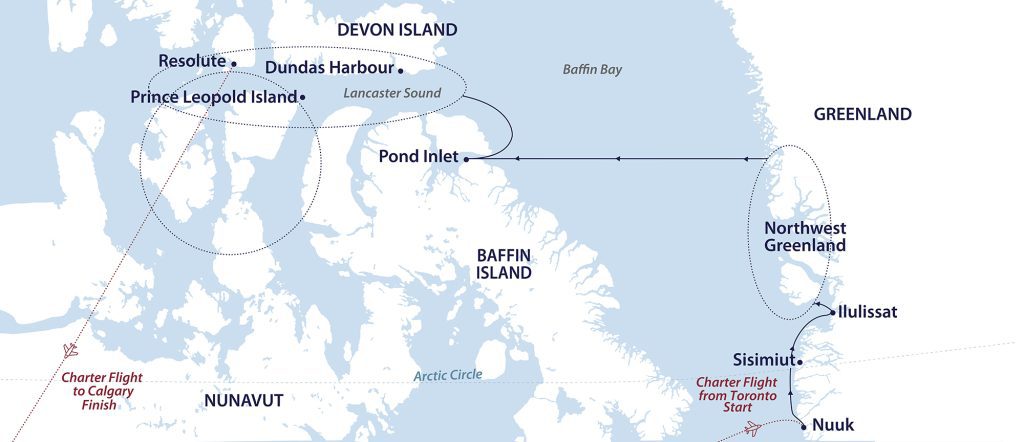
Trip Itinerary Overview:
Day 1: Arrive Toronto
Day 2: Charter flight to Nuuk, Greenland & Embarkation
Day 3: Sisimiut
Day 4: Illulissat
Days 5-6: Northwest Greenland
Day 7: At Sea
Day 8: Pond Inlet (Mittimatalik), Nunavut, Canada
Days 9-14: Northwest Passage Expedition Cruising
Day 15: Disembark in Resolute & Charter Flight to Calgary
Day 16: Depart Calgary



Tour Dates
- April 2027 to September 2027
| Dates | Availability | |
|---|---|---|
Aug 30 – Sep 14, 2027 (16 days) | Available | view pricing chart |
Itinerary
Day 1: Arrive in Toronto
Having made your way to Toronto Airport, check-in at our group hotel located near the airport for an overnight stay. Accommodation: Westin Toronto Airport Hotel (or similar)
Day 2: Charter flight to Nuuk, Greenland & Embarkation
After breakfast at the hotel, board our charter flight to Nuuk, Greenland, where our vessel the Sylvia Earle awaits. After boarding, there is time to settle into your cabin before our important safety briefings. This evening, meet your expedition team and crew.
Day 3: Sisimiut
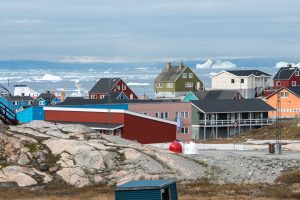
After a morning sailing north towards the Arctic Circle, we arrive in Sisimiut, Greenland’s second largest town. Sisimiut is located approximately 54 kilometres (33.5 miles) north of the Arctic Circle, meaning that during summer, you can experience the midnight sun here. The town is famous for the old blue church with the gate made of whale bone. In the cosy museum next door to the church, you will find an excellent reconstruction of an Inuit turf house as well as exhibits of local history and early life in Greenland. Approximately 4,500 years ago, the Saqqaq culture arrived from Canada and settled in the area. They lived here for approximately 2,000 years, after which they mysteriously disappeared from the area. The Dorset culture arrived around 500 CE and stayed until the 1200s until they were replaced by the Thule culture, and today, the majority of the population of Sisimiut are descendants of the Thule culture.
Day 4: Illulissat
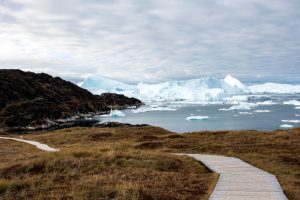
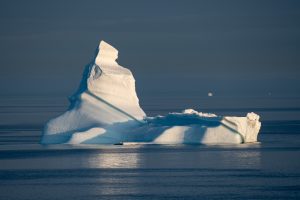
In the afternoon we arrive in Ilulissat. Known as the ‘birthplace of icebergs’, this region produces some of the most dazzling icebergs found anywhere on Earth. Hike to the UNESCO World Heritage-listed Icefjord viewpoint and stand in awe of its immensity. Sermeq Kujalleq, also known as Jakobshavn Glacier, is the most productive glacier – not only in Greenland but the entire Northern Hemisphere. It produces 20 million tonnes of ice each day, all floating into the Ilulissat Icefjord and Disko Bay.
Days 5-6: Northwest Greenland expedition cruising
Explore the remote northern reaches of West Greenland, where traditional Inuit settlements cling to the rugged coastline and towering icebergs drift through the deep, clear waters. Every day presents new possibilities, guided by your expedition team, who will hunt for the perfect location to explore the stunning fjord systems by Zodiac. Vast fjord systems such as Uummannaq Fjord, offers endless opportunities for adventure, every corner revealing jaw-dropping views, monumental icebergs, and vibrant rock formations that beg to be explored. Whether you’re cruising silently through the ice-choked waters, hiking across the colourful tundra, or visiting one of the remote communities that dot the coast, the options for discovery are limitless. Kayakers can paddle among the floating icebergs while keeping an eye out for humpback and minke whales. With the spirit of true expedition cruising, this region invites you to immerse yourself in the untamed beauty of Greenland’s northern frontier.
Day 7: At Sea
Find a spot in one of our many observation lounges and enjoy the spectacular surrounding landscapes. Our talented and knowledgeable expedition members will present informative and entertaining talks about the region that you’re travelling through.
Day 8 Pond Inlet (Mittimatalik), Nunavut, Canada
After clearance into Canada, we hope to visit Pond Inlet (Mittimatalik), a captivating Inuit community nestled on the northern tip of Baffin Island. Surrounded by towering ice-capped mountains, vast glaciers, and pristine fjords, this remote outpost offers an unparalleled wilderness experience. As you step ashore, you’ll be greeted by the warm hospitality of the local Inuit, whose deep connection to the land is evident in their culture and lifestyle. Immerse yourself in their traditions through engaging cultural encounters and gain insights into their unique perspective on life in the Arctic.
Days 9-14: Northwest Passage expedition cruising
In genuine expeditionary style, our itinerary for the following days is heavily dependent on weather conditions and unpredictable sea ice. The following places are some that we hope to visit.
Devon Island (Tallurutit)
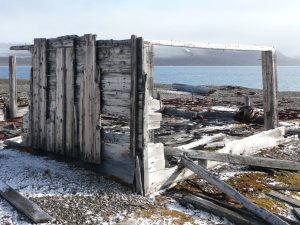
At a latitude of almost 75° degrees north, we are now truly in the High Arctic. Here, nutrient-rich waters support an abundance of wildlife, giving the area the moniker ‘wildlife superhighway’ of the Arctic. Devon Island (Tallurutit) is the largest uninhabited island on Earth and features stunning geology, with flat-topped mountains and glacial valleys giving Devon Island its unique character. We hope to visit Dundas Harbour to enjoy offers walks on undulating tundra, and perhaps some birdwatching. A dilapidated Royal Canadian Mounted Police outpost and remnants of a Hudson’s Bay Company trading post can be found here. In the bay, walruses are often present. Other possible places that we might visit include Croker Bay and Maxwell Bay.
Maxwell Bay (Tasiujaq)
Maxwell Bay is a broad, sheltered inlet that offers outstanding opportunities for exploration both on land and by sea. The surrounding tundra landscapes provide excellent hiking, with sweeping views of the rugged coastline and inland valleys. Wildlife is abundant in this remote area: muskoxen and caribou roam the open terrain, while polar bears are occasionally seen along the shoreline or on ice floes. The sheltered waters of Maxwell Bay are a haven for marine mammals, including harp seals, ringed seals, and bearded seals. Walruses are sometimes spotted hauled out on the ice or rocky beaches, adding to the rich wildlife experience. Birdlife is also notable, with seabirds such as glaucous gulls and northern fulmars often seen soaring overhead. The bay’s numerous coves and inlets create a sense of discovery at every turn, making it a rewarding destination for Zodiac cruises and shore landings.
Beechey Island (Iluvilik)
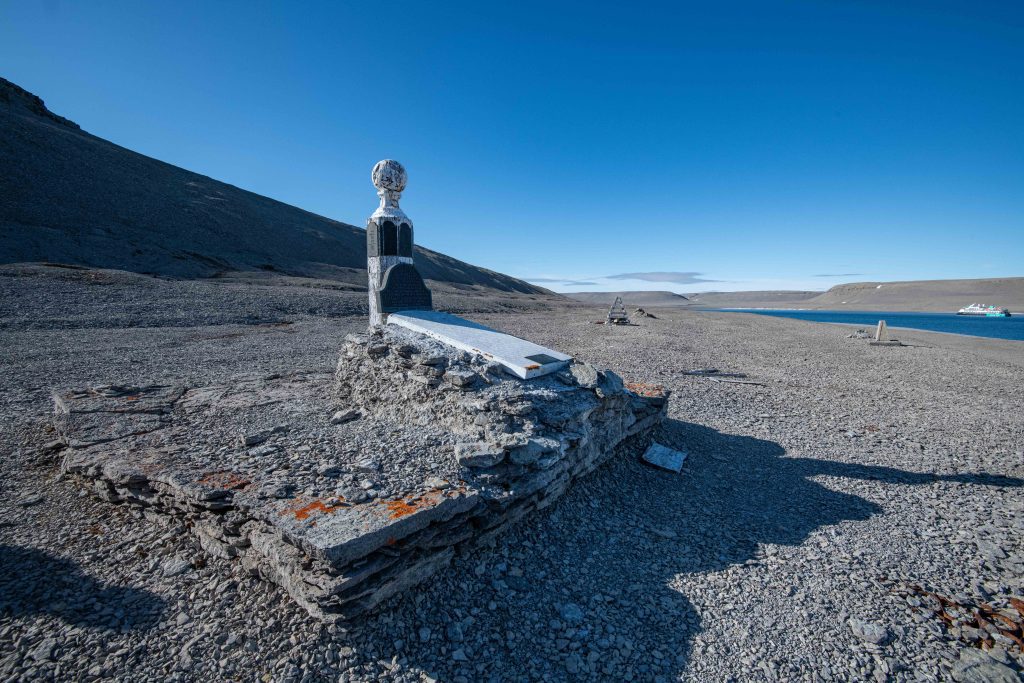
At the western end of Devon Island lies Beechey Island (Iluvilik), where we plan to land. Named after Frederick William Beechey, the island is a designated Canadian National Historic Site. During the Franklin expedition of 1845–46, Franklin attempted to sail through the Northwest Passage with HMS Erebus and HMS Terror, with perilous results – three of his men are buried here. Roald Amundsen landed at Beechey Island in 1903, during the first successful voyage by ship to fully transit the Northwest Passage from the Atlantic Ocean to the Pacific Ocean.
Radstock Bay
Just a short distance away, Radstock Bay offers a captivating contrast to the open sea. Here, we’ll disembark via Zodiac onto a beach strewn with remnants of the past. Explore the ruins of a Thule village nestled beneath the imposing Caswell Tower, where well preserved stone dwellings coexist with artifacts from later explorers. Witness the stark beauty of this remote bay, characterised by its dramatic cliffs, gravelly beaches, and the scattered remains of whale skeletons that have shaped the landscape and the lives of those who called it home.
Prince Leopold Island (Appait)
On the southern side of Lancaster Sound from Beechey Island lie the towering bird cliffs of Prince Leopold Island (Appait), a historic site where in 1848, English explorer James Clark Ross overwintered during the search for the missing Franklin expedition. Prince Leopold Island is the most important bird sanctuary in the Canadian Arctic, with approximately 500,000 birds nesting here in summer. Ringed seals are often spotted on the sea ice around the island and polar bears often lurk nearby.
Port Leopold
Port Leopold, a barren, windswept bay on the northeastern corner of Somerset Island (Inuktitut Kuuganajuk), is steeped in history. Here, the crews of HMS Enterprise and Investigator were forced to endure a harsh winter while searching for the lost Franklin expedition. Their presence is indelibly marked on a rock engraved with “1849” and the ships’ initials. The desolate landscape is punctuated by a lone Hudson Bay Company hut, a failed trading post from the 1920s.
We hope to hike and explore the coastline, discovering the historic Hudson Bay Company house and intriguing Inuit archaeological sites. Be amazed by the otherworldly formations shaped by the region’s freezing and thawing cycles, which our expedition team will detail during recap. Nearby, a cairn marks the spot where Ross’s rescue expedition left vital supplies.
Elwin Bay (Ikpiarjuk)
Situated on the southeastern coast of Somerset Island, Elwin Bay is a breathtaking, wide inlet famous for its wildlife, particularly polar bears. This area was historically used by hunters and today remains an important habitat for bears who hunt along the ice edge and swim between the scattered ice floes. During summer, beluga whales are sometimes seen offshore, and the rocky beaches may reveal evidence of Arctic foxes and seabird colonies. The surrounding landscapes offer stunning contrasts, from rolling tundra to rugged limestone cliffs. Elwin Bay’s rich natural history and raw beauty make it a highlight for wildlife photography.
Batty Bay, Somerset Island
Nestled along the northeastern coast of Somerset Island, Batty Bay is a narrow, sheltered fjord steeped in Arctic exploration history. In the 1850s, it served as a winter refuge for expeditions searching for Sir John Franklin’s lost ships. Here we will hike the surrounding tundra slopes and trace the paths of early explorers. The calm waters of the bay are perfect for Zodiac cruising, with opportunities to spot ringed seals on ice floes and polar bears along the rocky shoreline. The cliffs and rugged terrain also attract a variety of nesting seabirds.
Bellot Strait
Bellot Strait is one of the most legendary waterways of the Arctic; a narrow, fast-flowing channel that separates the northern tip of the Boothia Peninsula from Somerset Island. Just two kilometres wide at its narrowest point, this passage is known for its strong tidal currents, shifting ice, and dramatic scenery. Bellot Strait marks the northernmost point of mainland North America and was first navigated by explorers seeking the elusive Northwest Passage. Today, it remains a thrilling and challenging route for expedition vessels. Wildlife is often seen along the shores and in the water, including polar bears, seals, and occasionally beluga whales riding the tides. Steep cliffs and rugged hills frame the strait, offering a dramatic backdrop for cruising.
Day 15: Disembark in Resolute, fly to Calgary
In Resolute, farewell the crew, expedition team and fellow travellers before a Zodiac shuttle whisks you ashore. Transfer to the airport for a charter flight to Calgary, where you will transfer to your group hotel and stay overnight. Accommodation: Residence Inn by Marriott Calgary Downtown / Beltline District
Day 16: Depart Calgary
After breakfast, check-out of your room and continue your journey.
In true expedition style we encourage exploration and adventure, offering flexibility in challenging environments in a way that puts you among the action to see and do as much as possible. This itinerary is only a guide and subject to change due to ice and weather conditions.
Trips & Rates
Please note, rates are Per Person in USD
Availability & prices are subject to change at anytime
Aug 30 – Sep 14, 2027 (16 days)

| Start: | Toronto, ON, Canada |
| End: | Calgary, AB, Canada |
| Cabin Category | Aurora Stateroom Triple | Aurora Stateroom Superior | Balcony Stateroom C | Balcony Stateroom B | Balcony Stateroom A | Balcony Stateroom Superior | Junior Suite | Captain’s Suite | Solo Balcony Stateroom C | Solo Balcony Stateroom B | Solo Balcony Stateroom A |
|---|---|---|---|---|---|---|---|---|---|---|---|
| Per Person Price in USD | $25,495 | $27,695 | $28,495 | $29,995 | $32,195 | $35,195 | $41,995 | $47,995 | $28,495 | $29,995 | $32,195 |
| Discount | Save 15% | Save 15% | Save 15% | Save 15% | Save 15% | Save 15% | Save 15% | Save 15% | |||
| Discounted Per Person Price | $21,671 | $23,541 | $24,221 | $25,496 | $27,366 | $29,916 | $35,696 | $40,796 | $28,495 | $29,995 | $32,195 |
| Availability | Open | Limited: 3 berths left | Limited: 3 berths left | Open | Open | Open | Open | Limited: 2 berths left | Full | Full | Full |
Adventure Options:

Voyage Ship
Sylvia Earle
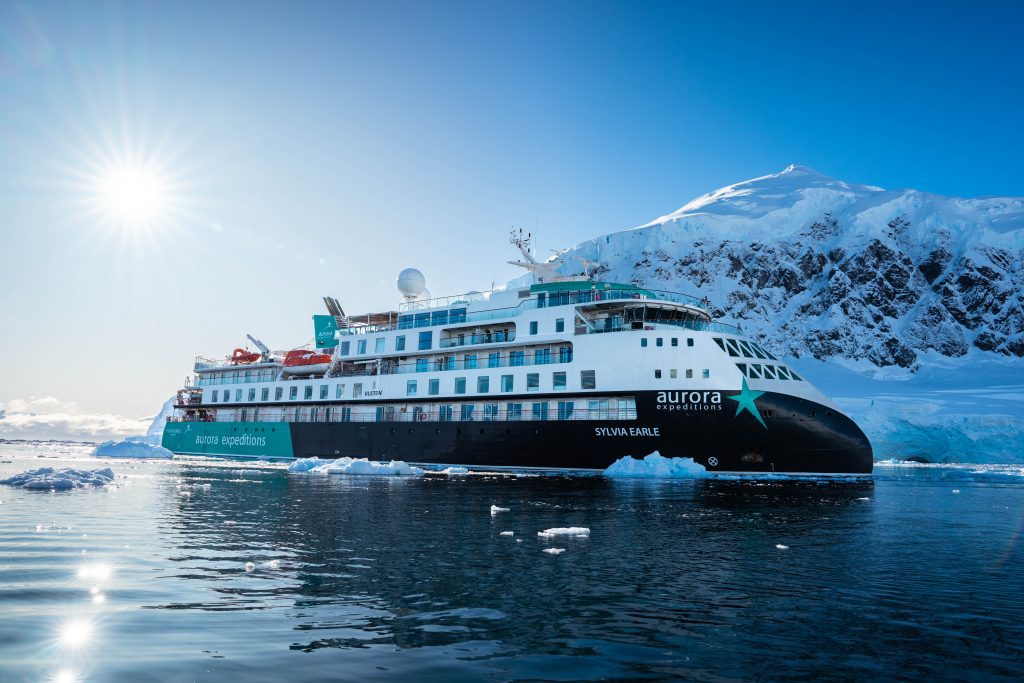
This new purpose-built small expedition vessel honors the highly accomplished marine biologist, oceanographer and explorer, Dr. Sylvia Earle. As the first woman to become chief scientist of the U.S. National Oceanic and Atmospheric Administration, and named by Time Magazine as its first “Hero for the Planet” in 1998 – this ship pays tribute to Dr. Sylvia Earle’s long-standing conservation efforts for marine protected areas and ocean wildlife.
Sylvia Earle Cabins & Deck Plan
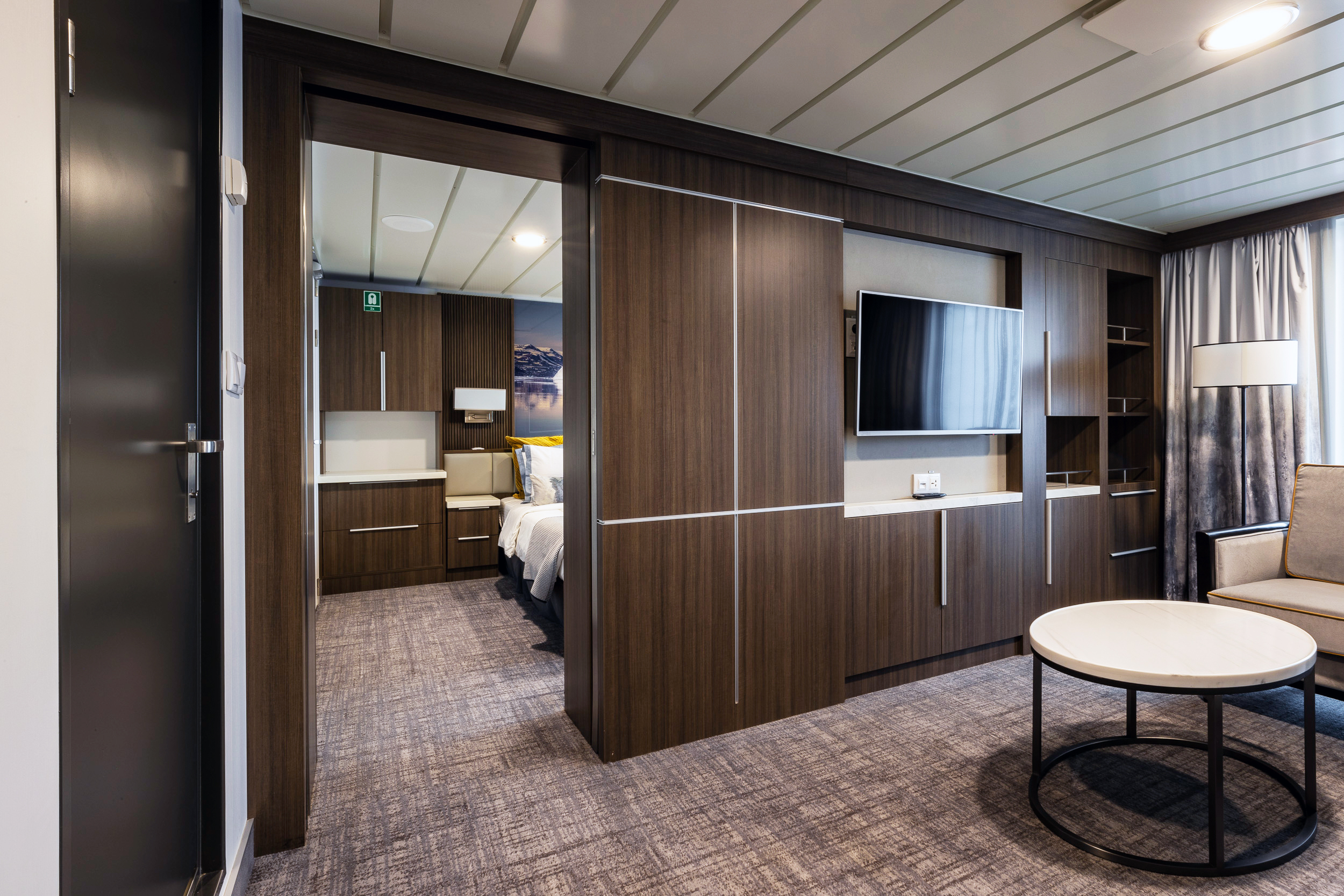
Captain’s Suite

DECK 4
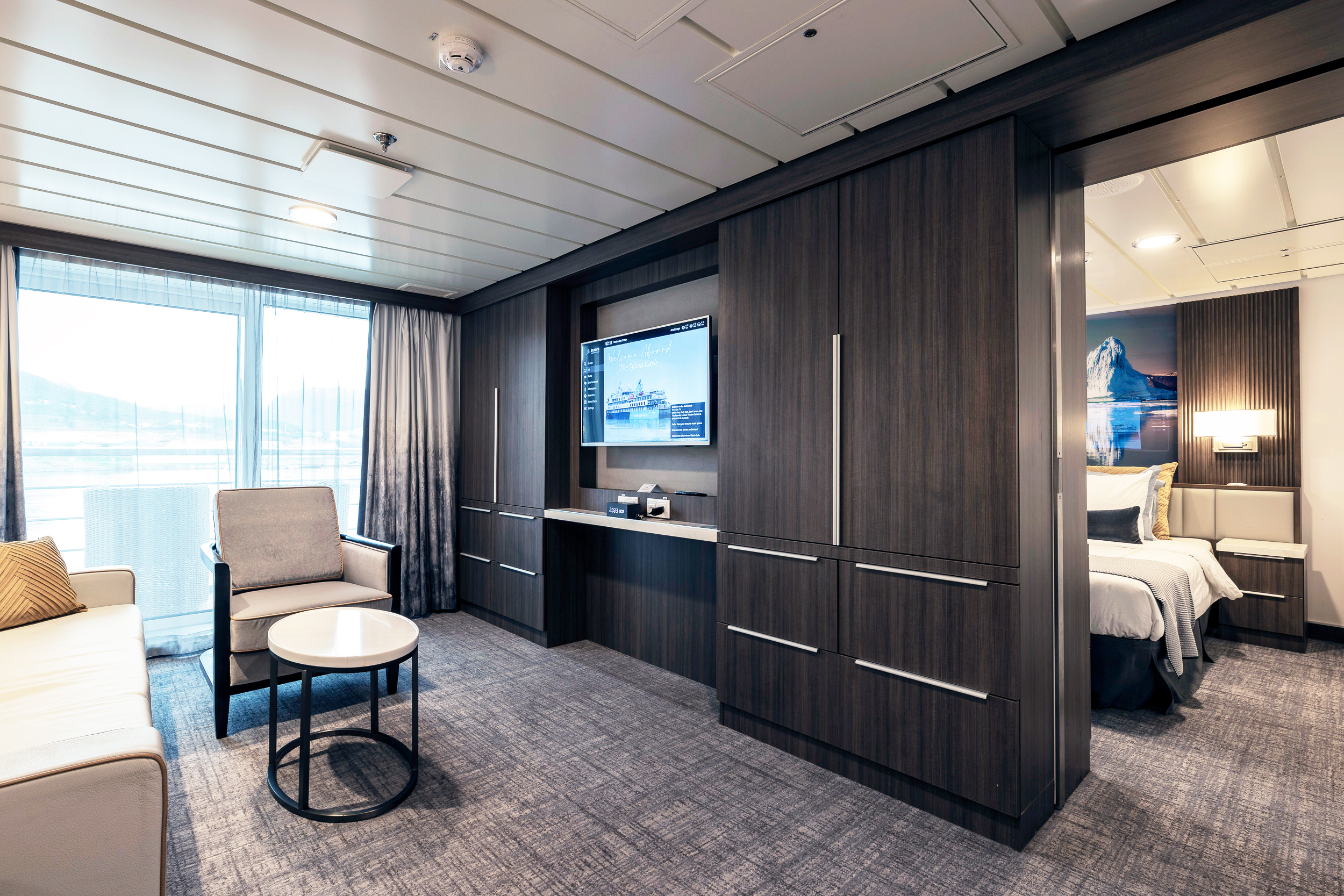
The singular Captain’s Suite on Sylvia Earle is the most spacious accommodation onboard and has a prime low midship location. Complete with large lounge area, balcony, walk-in wardrobe and en-suite. The Captain’s Suite features additional amenities including 1 free pair of binoculars per suite, free stocked mini bar (replenished as needed) and 1 free bottle of champagne. Size listed is cabin and balcony size combined.

437 sq. ft. (40.6m2)

1-2

1 king or 2 twins
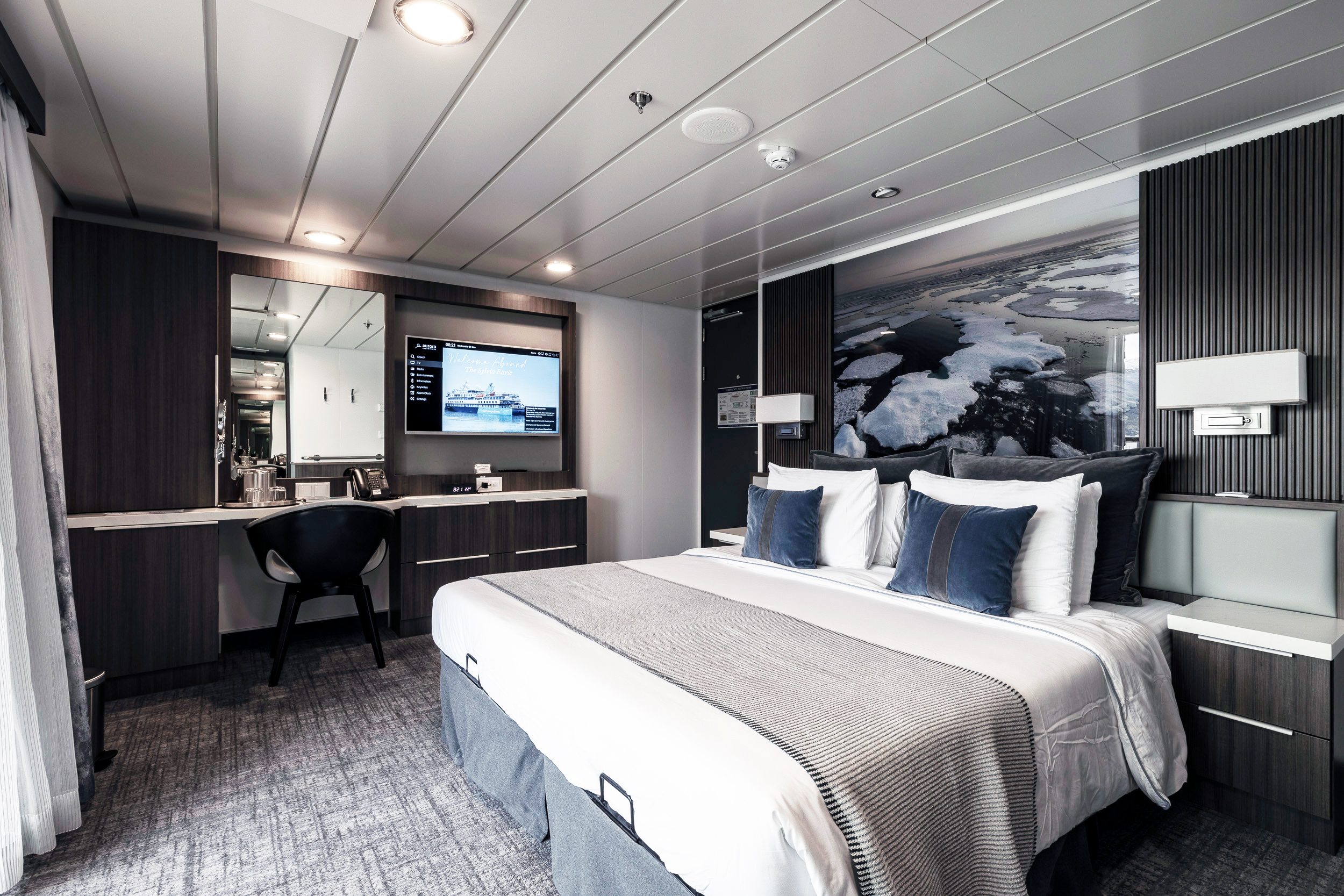
Junior Suite
DECK 7
The four Junior Suites take in some impressive scenery from their vantage points high on the ship. When you aren’t enjoying a landing, you can relax in the suites’ separate lounge area, or just watch the world float by from the private balcony. The Junior Suite features additional amenities including 1 free pair of binoculars per suite, free stocked mini bar (stocked once only) and 1 free bottle of champagne. Size listed is cabin and balcony size combined.
417 – 420 sq. ft. (38.8 – 39.1m2)
1-2
1 king or 2 twins
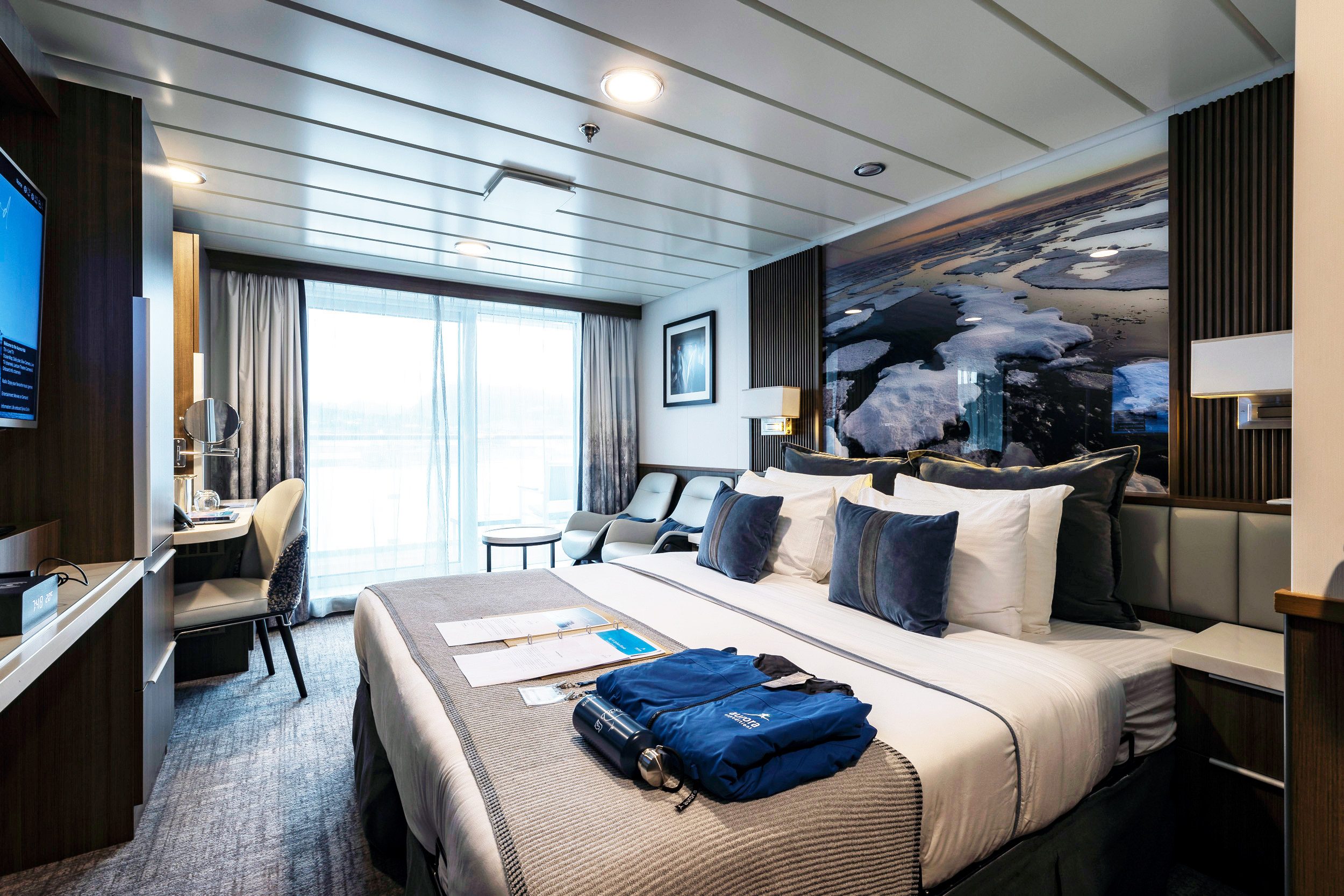
Balcony Stateroom Superior
DECK 4
DECK 6
With a bit more room to stretch the legs, the Balcony Stateroom Superior cabins are perfect for polar adventurers who travel with plenty of gear. Staterooms feature floor to ceiling windows, en-suite bathrooms and a comfortable desk area. Some of these rooms are equipped with wheelchair accessible bathrooms. Size listed is cabin and balcony size combined.
284 – 336 sq. ft. (26.4 – 31.2m2)
1-2
1 king or 2 twins
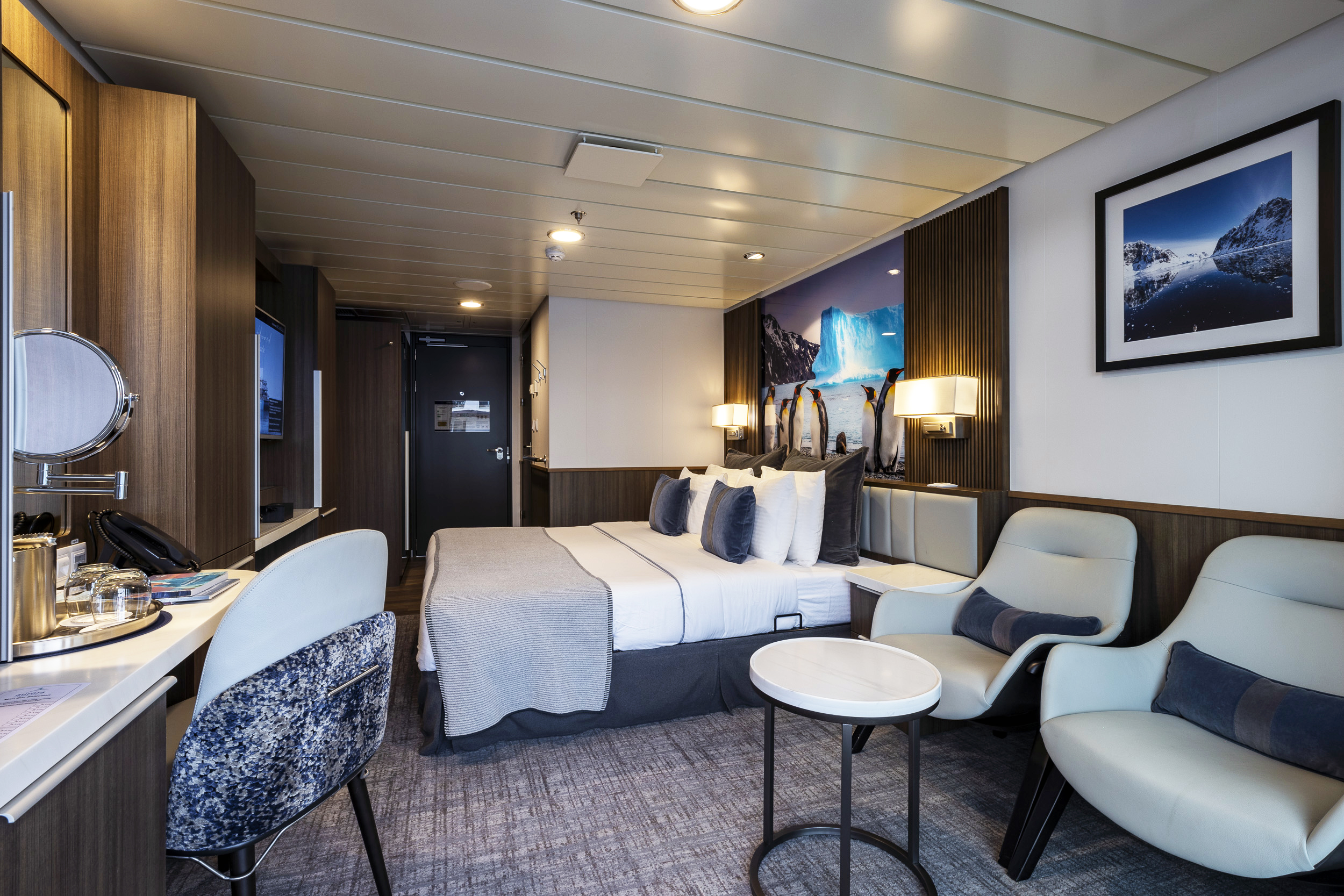
Balcony Stateroom Category A
DECK 4
DECK 6
The 23 Balcony Stateroom A cabins are a premium cabin and the most abundant on board. These cabins are located in preferred positions which provide easy access between decks via the internal stairs or elevator. Size listed is cabin and balcony size combined. Starting the Arctic 2026 season there will be 6 dedicated Solo Balcony Stateroom A cabins (#407, 409, 410, 412, 607 & 610) available with no single supplements. Pricing based on full brochure fare. See pricing grid for details.
226 – 301 sq. ft. (21 – 28m2)
1-2
1 king or 2 twins
Balcony Stateroom Category B
DECK 4
DECK 6
The 17 Balcony Stateroom B Cabins are located at the fore and aft of Deck 4 & 6. Many are fitted with interconnecting features making them great for families or groups. Size listed is cabin and balcony size combined. Starting the Arctic 2026 season there will be 2 dedicated Solo Balcony Stateroom B cabins (#606 & 603) available with no single supplements. Pricing based on full brochure fare. See pricing grid for details.
202 – 235 sq. ft. (18.8 – 21.8m2)
1-2
1 king or 2 twins
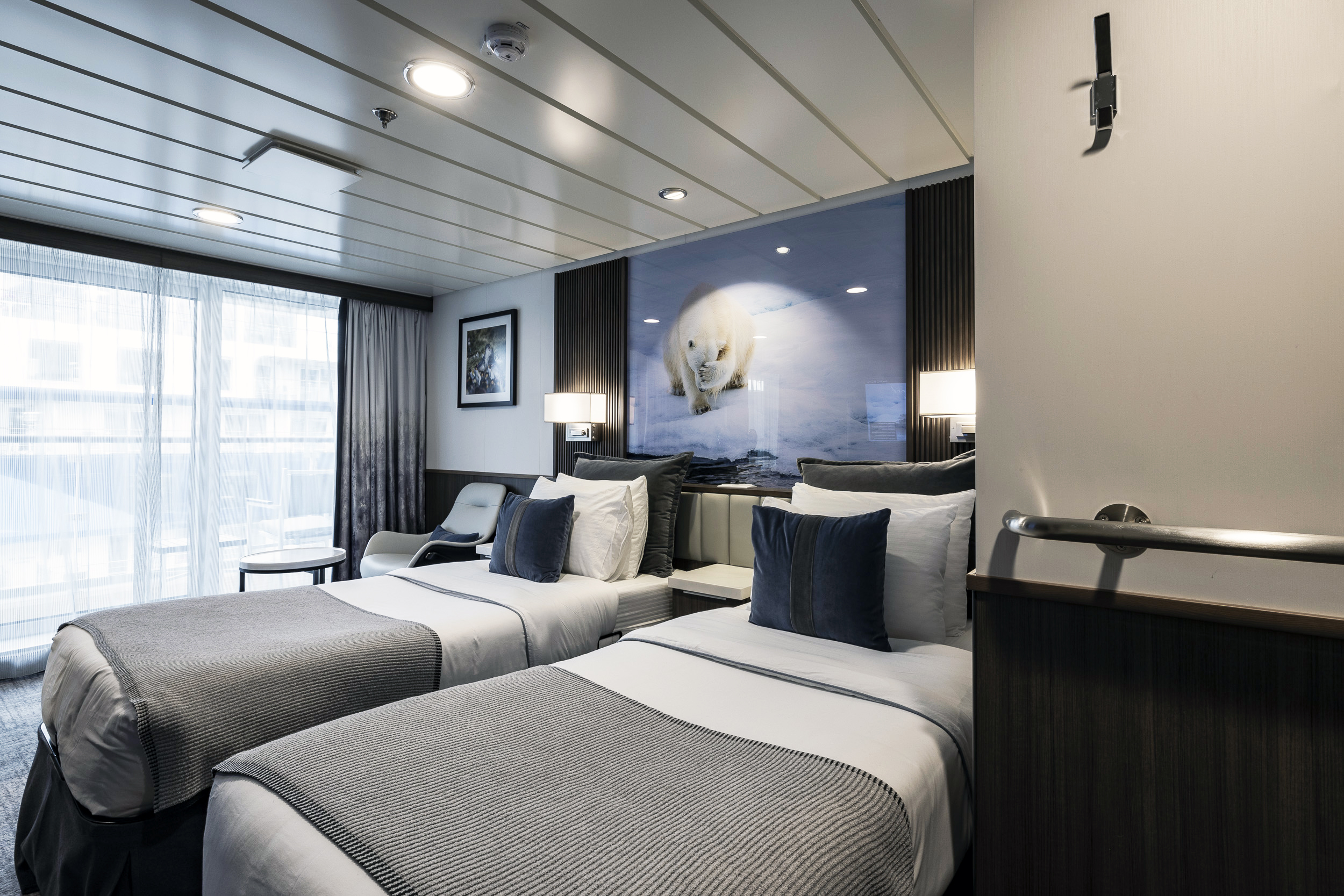
Balcony Stateroom Category C
DECK 4
DECK 6
The 11 Balcony Stateroom C cabins are the most economical balcony stateroom, fitted with all the necessities and comfortable for up to 2 people. These cabins are either in the most forward or aft location or in a mid-ship location with a smaller cabin size. Size listed is cabin and balcony size combined. Starting the Arctic 2026 season there will be 2 dedicated Solo Balcony Stateroom C cabins (#611 & 614) available with no single supplements. Pricing based on full brochure fare. See pricing grid for details.
181 – 233 sq. ft. (16.8 – 21.6m2)
1-2
1 king or 2 twins
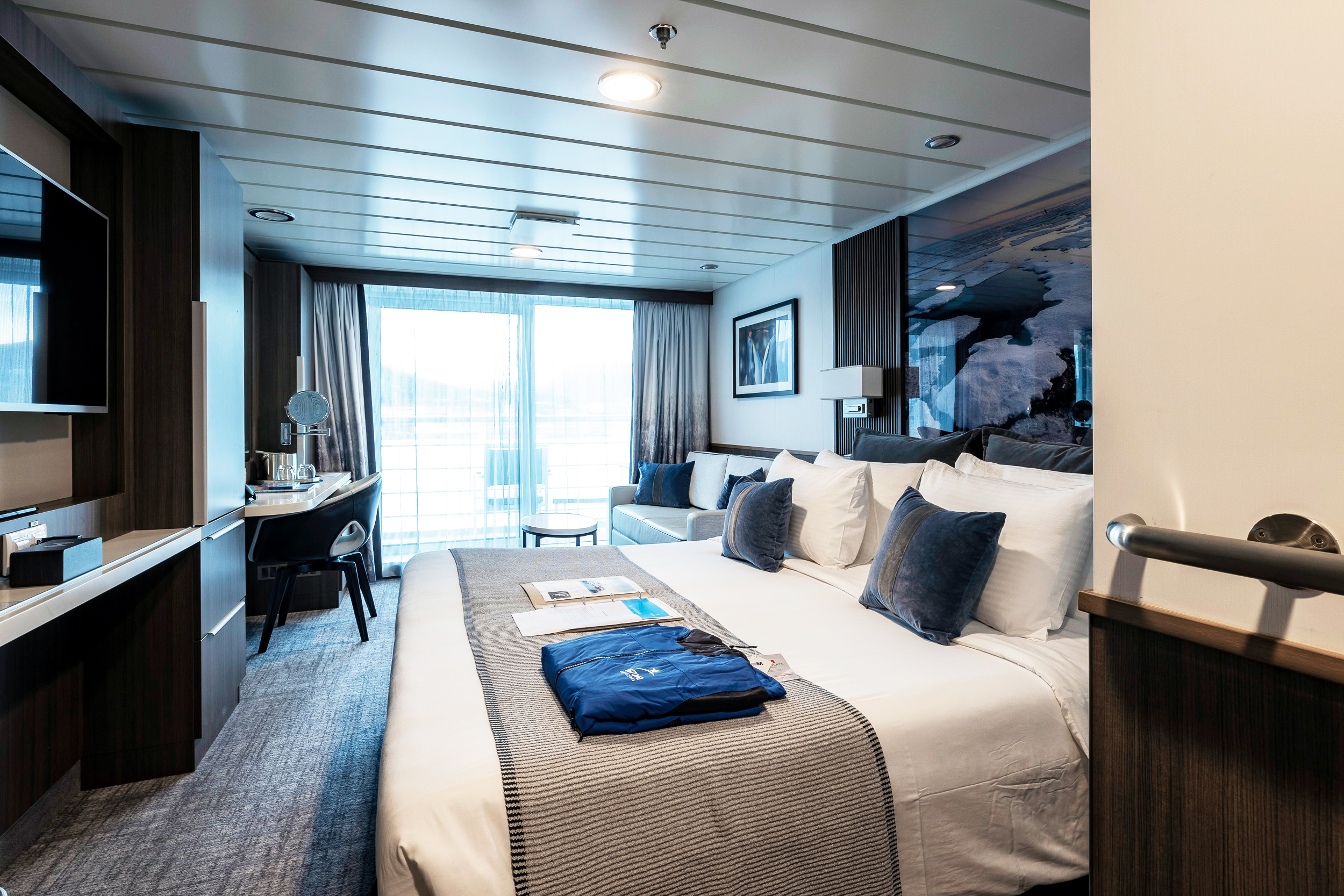
Aurora Stateroom Superior
DECK 7
With a bit more room to stretch the legs, the Aurora Stateroom Superior are perfect for polar adventurers who travel with plenty of gear. The Staterooms feature French balconies, floor to ceiling windows, en-suite bathrooms and a comfortable desk area.
185 – 195 sq. ft. (17.2 – 18.1m2)
1-2
1 king or 2 twins
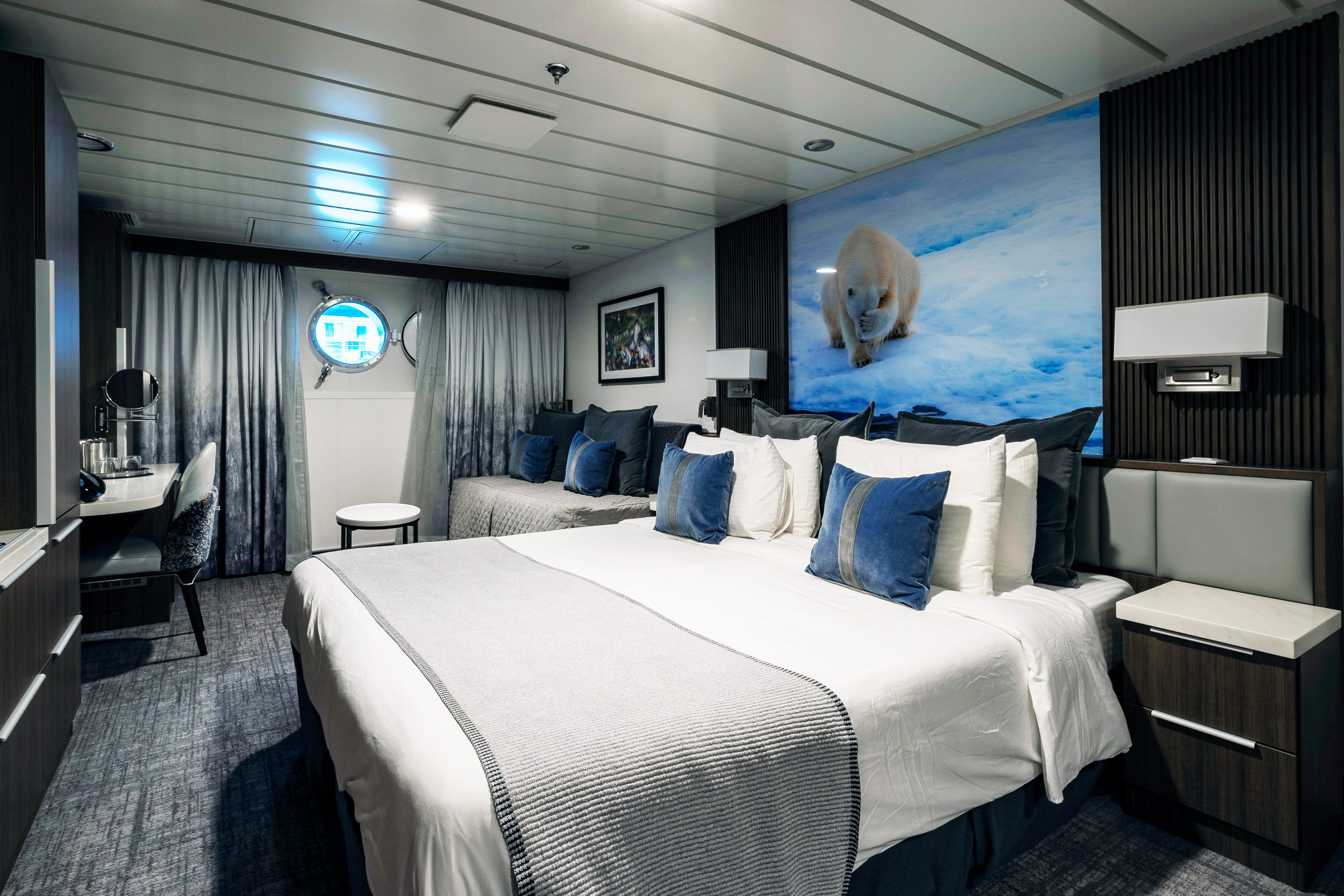
Aurora Stateroom Triple Share
DECK 3
There are two Aurora Stateroom Triple cabins featuring portholes, all with private en-suites. Located low on the ship, they’re close to the mudroom and loading platforms.
215 sq. ft. (20m2)
1-3
3 twins or 1 king + 1 twin
Inclusions/Exclusions
Inclusions:
- All transfers mentioned in the itinerary.
- One night’s hotel accommodation including breakfast, in Toronto on Day 1.
- One night’s hotel accommodation including breakfast, in Calgary on Day 15.
- Charter flight from Toronto to Nuuk on Day 2.
- Charter flight from Resolute to Calgary on Day 15.
- On-board accommodation during voyage including daily cabin service.
- All meals, snacks, tea, coffee, soft drinks & juices during voyage.
- Beer and house wine with dinner.
- Captain’s Farewell reception including four-course dinner, house cocktails, house beer and wine, non-alcoholic beverages.
- All shore excursions and Zodiac cruises.
- Educational lectures and guiding services provided by Expedition Team.
- Complimentary access to onboard expedition doctor and medical clinic (initial consultation).
- One 3-in-1 waterproof polar expedition jacket.
- Complimentary use of Muck Boots during the voyage.
- Comprehensive pre-departure information.
- Port surcharges, permits and landing fees.
- Gratuities during excursions and enrichment program for local guides, drivers, venues and local sites.
- Wi-Fi. Please note we travel to remote regions and therefore the connection can be unreliable.
Exclusions:
- International or domestic flights not mentioned in the itinerary, unless specified in the itinerary.
- Transfers – unless specified in the itinerary.
- Airport arrival or departure taxes.
- Passport, visa, reciprocity and vaccination fees and charges.
- Travel insurance or emergency evacuation charges.
- Hotel accommodation and meals unless specified in the itinerary.
- Optional excursions and optional activity surcharges.
- All items of a personal nature including but not limited to alcoholic beverages and soft drinks (outside of dinner service), gratuities, laundry services, personal clothing, medical expenses, or phone charges.
Note: A $15 USD per person per day gratuity for the crew is automatically added to your onboard account. It is at your discretion if you would like to remove the tip (or adjust the amount) when you settle your bill. It is not necessary to tip the expedition team members. This gratuity amount is included for suites as part of their ‘Suite Benefits’.
Solo Travelers
Are you traveling alone? Solo travelers have the following options.
- Book into a share cabin into a share cabin with another (or other) guests of the same gender
- Book a Solo Balcony Stateroom C, B or A
- Book a twin cabin at solo occupancy at 1.5x the per person share price